research / 2025–2026
Computational Properties of Organized Complexity Simulation
Exploring the computational foundations of behavioral simulation, with a theoretical framework and LLM-based multi-agent modeling.
Research question
What computational properties make a simulation a useful model of organized complexity and human behavior?
Motivation
Organized complex systems are widely observed in real-world domains such as financial markets, urban operation, and collective behavior. They are typically characterized by open-ended evolution, nonlinear feedback, and multi-agent interaction. Such systems are difficult to fully characterize using traditional analytical models, and they are also difficult to extrapolate over long horizons using purely data-driven methods. The central difficulty lies in the fact that finite observations cannot recover the complete state of the system, and finite computation cannot exhaust all possible future evolutionary paths. Therefore, the credibility of simulation results and the effectiveness of the simulation process cannot be judged merely by the similarity of a single output. An independent framework for evaluating simulation validity is required.
A behavioral simulation framework
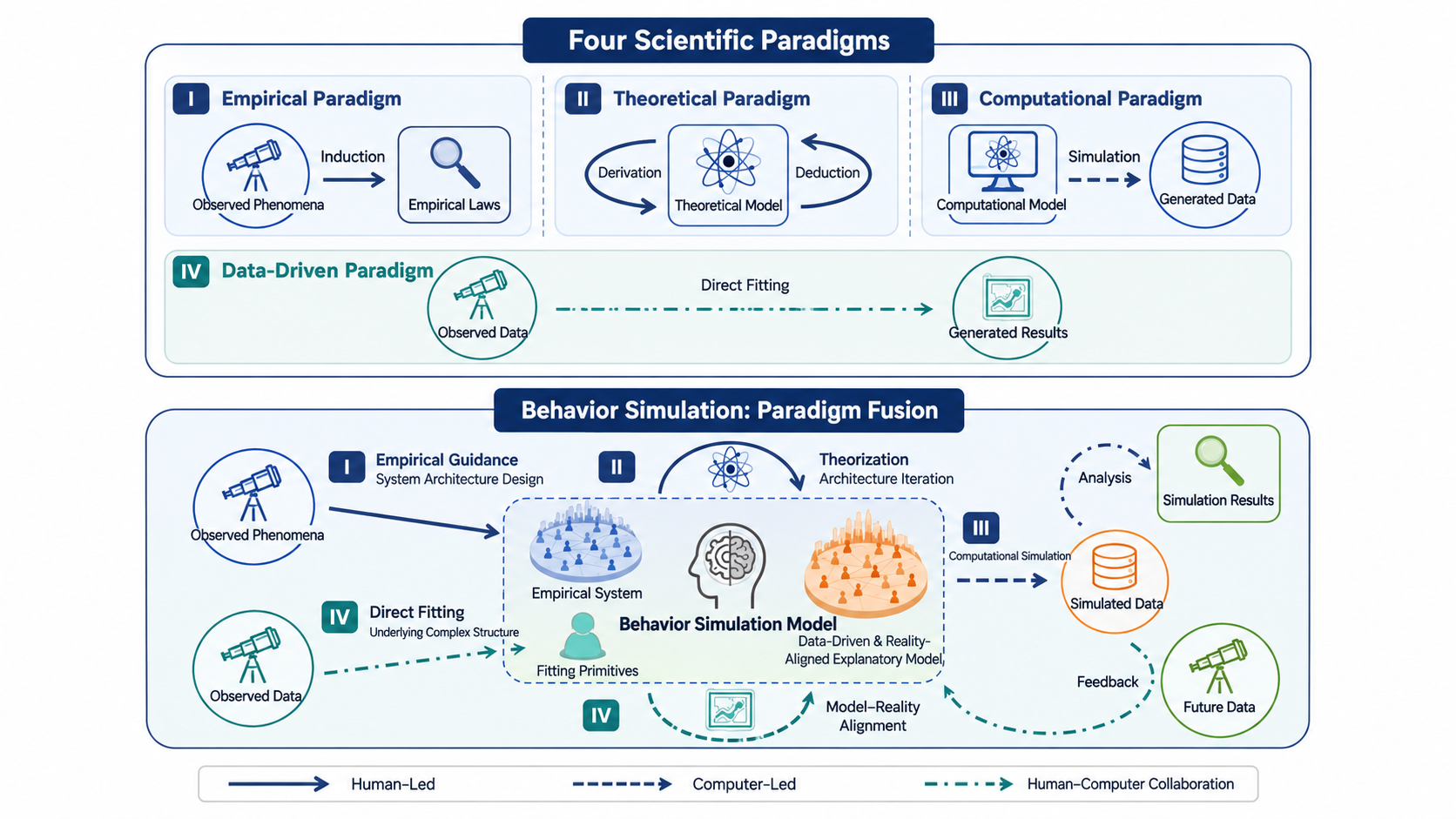
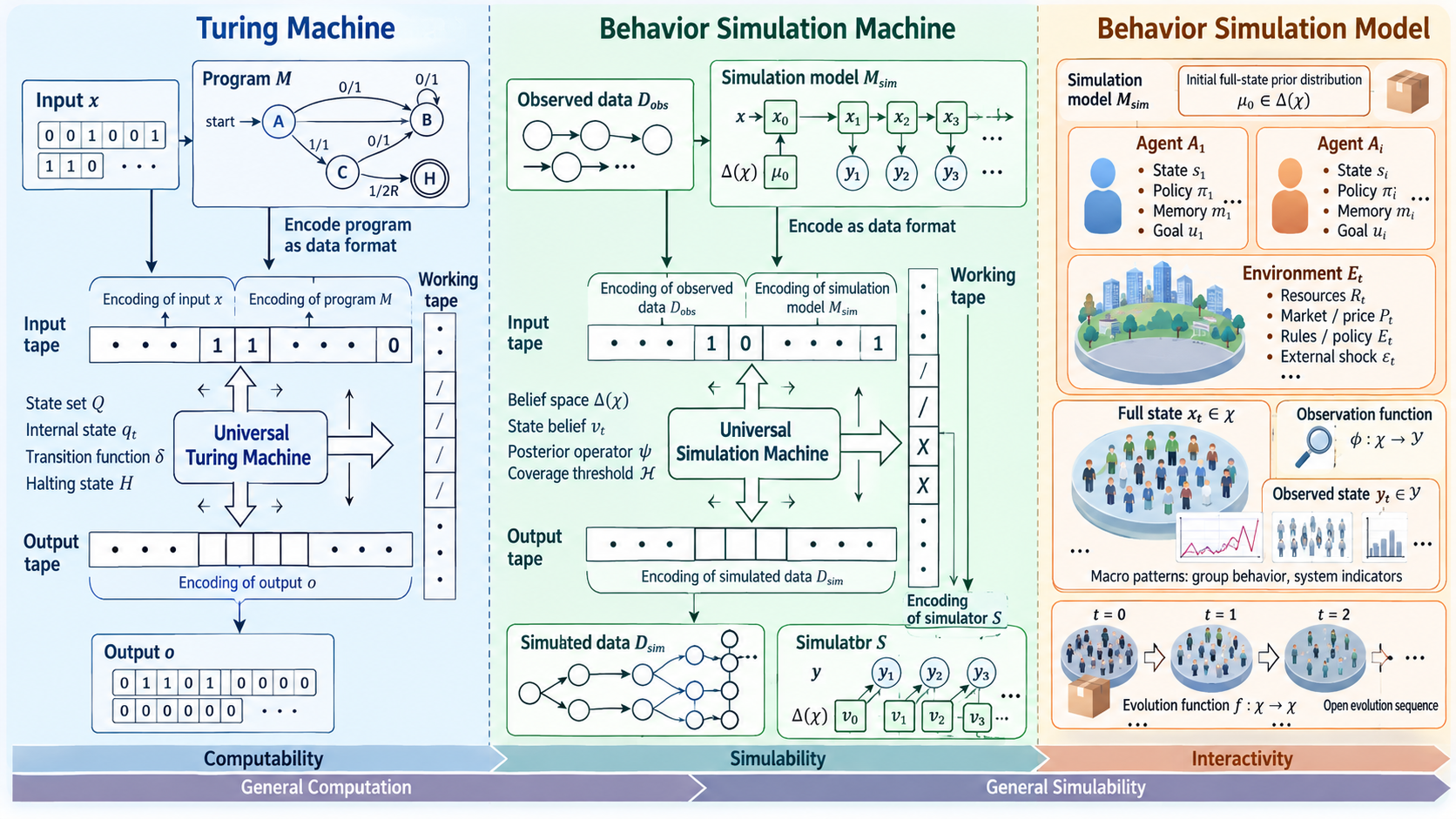
To address this validity-evaluation problem, this thesis adopts a paradigm-integration perspective and treats behavioral simulation as an executable approach for studying organized complex systems. To characterize the structure and properties of behavioral simulation under finite observation and finite computation, this thesis develops a theoretical framework of the behavioral simulation machine. This framework consists of two components: a behavioral simulation model, which describes how behavior is generated under complete states, and a simulator, which forms state beliefs from finite observations and unfolds future trajectories accordingly. On this basis, this thesis proposes three computational properties: state completeness, process computability, and distribution consistency. These properties respectively characterize whether the simulator can cover the main complete states compatible with observations, whether observation alignment and future rollout can be completed within a finite budget, and whether the simulated distribution of future trajectories can explain the subsequent observations of the behavioral simulation target. Furthermore, to make these properties executable for evaluation, this thesis proposes a behavioral simulation test method: model-internal benchmark trajectories are used to evaluate simulatability, while external benchmark trajectories are used to evaluate the explanatory ability for behavior sequences to be interpreted.
Evaluation
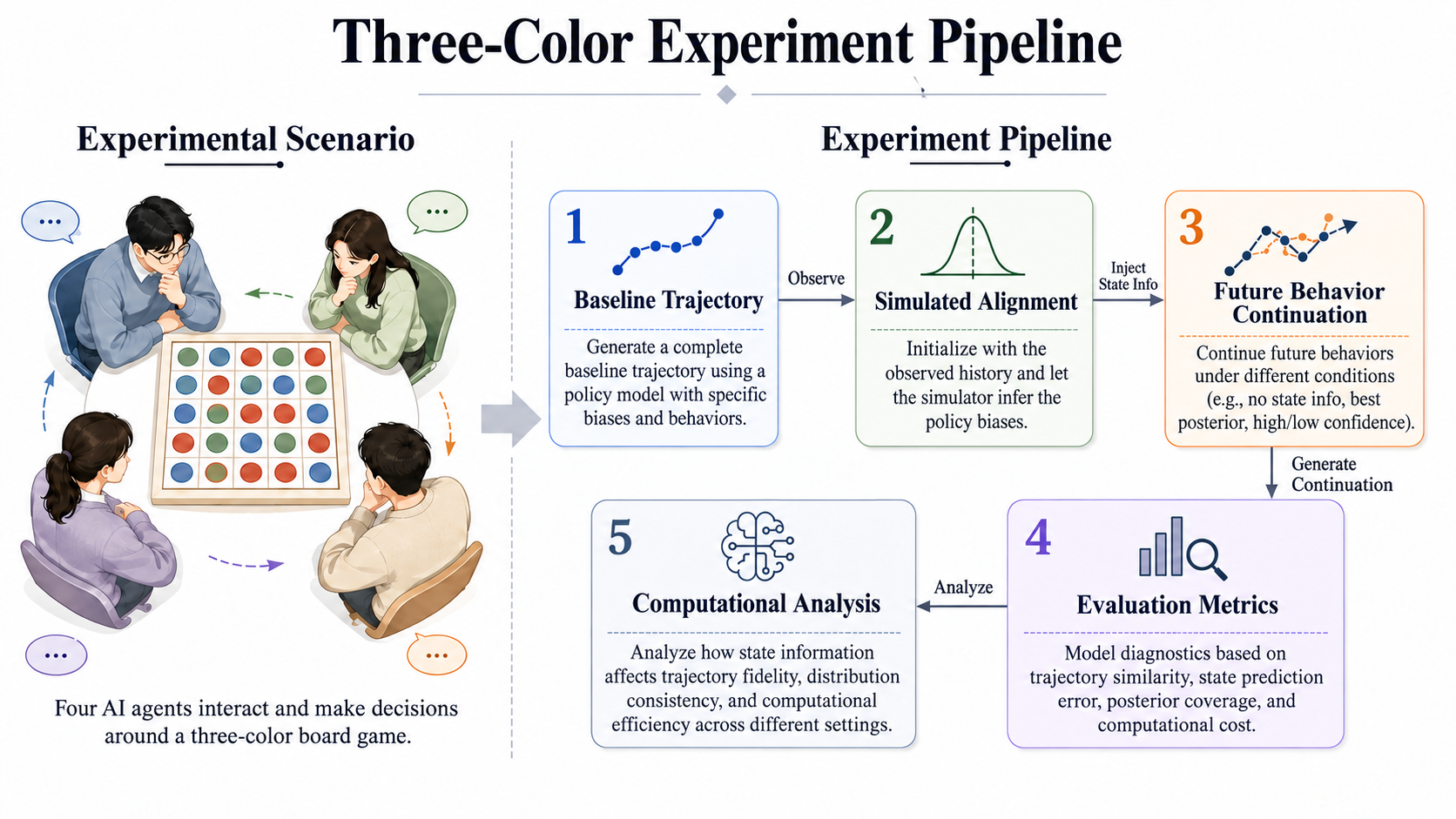
In the experimental part, this thesis constructs a three-color multi-agent interaction system driven by DeepSeek-7B, and conducts behavioral simulation tests in a controlled environment involving hidden preferences, language interaction, and task conflict. The results show that, after introducing state beliefs obtained through observation alignment, behavioral simulation explains future trajectories better than direct continuation, long-context continuation, and no-belief-state simulation. It also retains a certain explanatory effect on behavior sequences generated from different sources. These results indicate that the advantage of behavioral simulation lies in forming more constrained future explanations through state constraints and process rollout. Meanwhile, the experiments translate state completeness, process computability, and distribution consistency into measurable indicators such as state coverage, sampling budget, and trajectory explanation, thereby verifying the operability of behavioral simulation testing as an evaluation procedure. Overall, this thesis provides an executable framework for behavioral simulation of organized complex systems, covering both theoretical modeling and validity testing.